
Bunker game rules: how to play online
The full guide to the online version of the «Bunker» board game — the official adaptation by Economicus publishing (edition 3.3), including the Bunker-B, Alpha and 18+ sets. Inside: how to create a game and invite friends, what the host controls, character cards, rounds, discussion, voting and the finale.
Bunker is a social survival game. A catastrophe has hit the world, the only shelter is a bunker, and there are fewer places inside than people at the door. Everyone gets a character made of six face-down cards, and over five rounds the group decides who stays outside.
AI characters play on equal footing with live players: each has its own temper, and they argue, bargain and vote on their own. No moderator needed — the game runs itself: it deals the cards, announces the catastrophe and the rounds, opens discussions and votes, and sums up the ending.
The online version is the official adaptation of the «Bunker» board game by Economicus (designed by Oksana Soldatova). It includes Bunker 3.3, Bunker-B, Generation Alpha and the 18+ set, plus content that never made it into the boxes.
Starting a game
- On the homepage press «Play with friends and AI» — the game is created right away.
- You land in the lobby: that's where you set the number of players, the mission type, the card sets and the AI tempers.
- Invite friends with a link — free seats are taken by AI characters.
- Press «Start game».
Creating a game needs an access code. The demo tier gives 5 games per month: two can be played one-on-one with AI, the other three need at least one live player at the table. A subscription lifts that limit and unlocks more seats, card sets and AI tempers.

AN INVITED PLAYER NEEDS NO CODE
A friend who follows your link plays free and without registration — they just open the link and take a free seat. The code is only needed by whoever creates the game.
Inviting friends
The easiest way is the «Invite friends» button in the lobby: it hands the invitation to a messenger. Or just copy the lobby address from your browser's address bar and send it to a friend — that's enough.
You don't have to wait for a full table — AI takes the free seats. Someone can also join as a spectator: they see the whole game but neither play nor vote.
If a player leaves and doesn't come back, the host replaces them with an AI in one tap — the bot picks up the same character with the same cards. You can do the same to yourself with «Hand over to AI». Closing the browser doesn't break the game: come back through the same link within half an hour and your seat is still yours.
What the host controls
The host is whoever created the game. Lobby settings are theirs alone.
- Number of players — 4 to 8. The demo tier opens 4 seats, Basic 6, Premium 8. How many places there are inside the bunker the game works out itself, by the board game's table.
- Mission type — «Salvation» or «Revival» (6 players and up).
- Card sets — one or several at once; at least one base set is required.
- Rare cards — the «Include rare cards» switch: the collections of everyone at the table are mixed into the shared deal.
- AI model — one for the whole game; it shapes how the bots speak.
- The temper of every AI — 16 characters to choose from.
- A word about the game — a message on the sign, seen by everyone who opens the link.
- Start — only the host can begin.
Any live player can add a word about themselves — that line is kept in the profile and fills itself in for the next games.
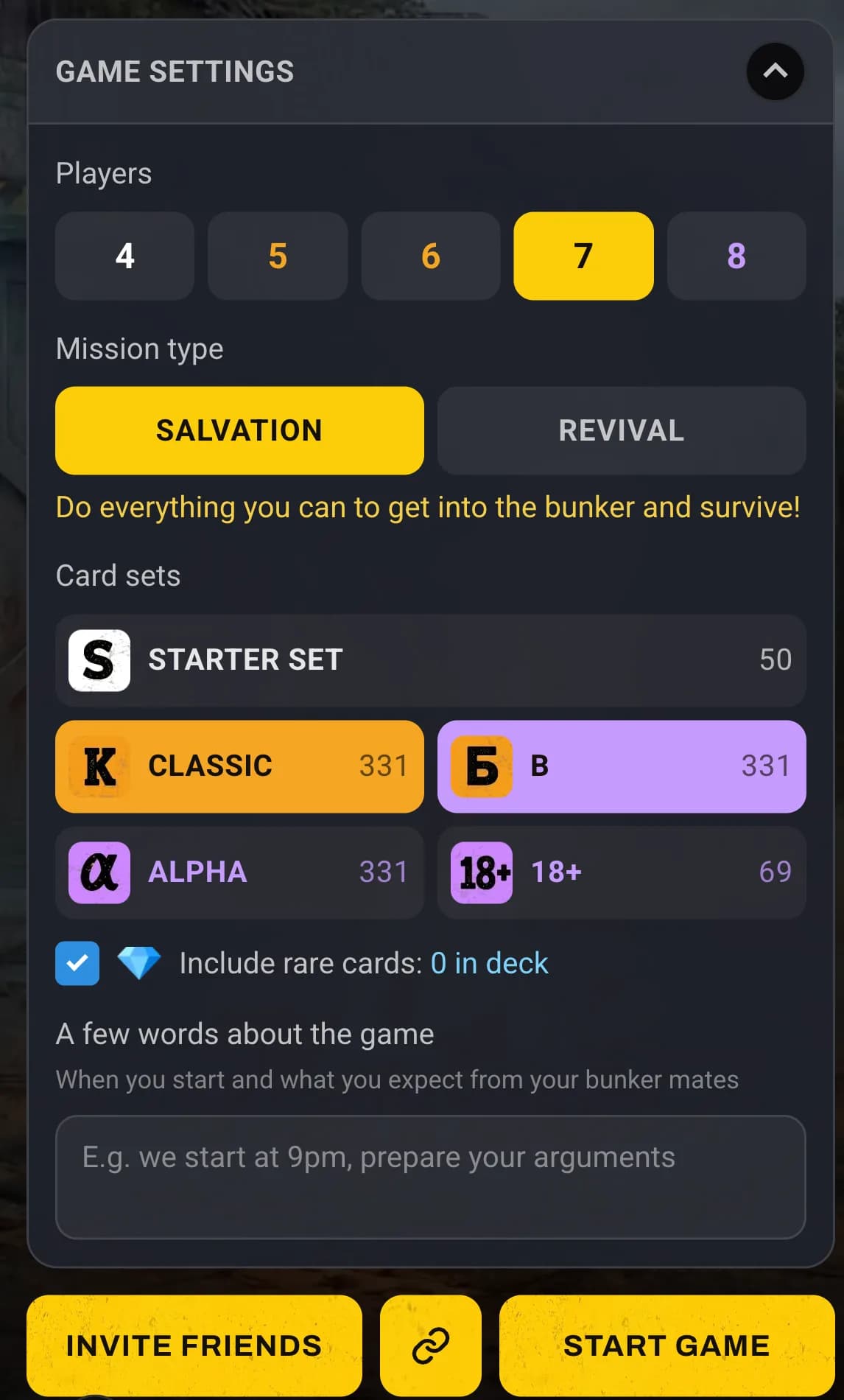
Card sets
The game holds more than 1100 cards across five sets. The ones you pick go into a single deck.
Base sets — at least one is required:
- Starter Set (50) — a compact set for getting to know the game and for short rounds.
- Bunker Classic (331) — the canonical «Bunker» edition 3.3 by Economicus.
Add-ons — only together with a base set:
- Bunker-B (331) — bleak catastrophes, harsh cards, provocative facts.
- Bunker-Alpha (331) — the «Generation Alpha» set: modern professions, social media, current phobias.
- 18+ (69) — for adult company only: explicit cards and situations.
Sets combine freely: «Classic + Alpha» is 662 cards in the deck, «Bunker-B + 18+» is the harshest version of the game.
The demo tier opens the Starter Set, Basic adds Bunker Classic, Premium unlocks all five.
Line-ups
The table has 4 to 8 seats, and you can fill them however you like.
- AI theatre — every seat is AI. Watch the tempers argue.
- Solo — you alone among AI. Try to convince the bots you're worth saving.
- Mix — a few live players plus AI. The most common mode.
- Humans only — every seat taken by a live player. The classic format.
AI tempers
The temper sets the speech style and the table strategy: how the character pushes, whom they defend and what they build their arguments on. Four are open to everyone, the rest come with a subscription.
Free
 BulldozerRude and blunt, cuts straight to the point
 HystericPanicker, dramatises every situation
 PokerfaceTotally indifferent — praised or about to be exiled, zero reaction
 StarNarcissist, makes everything about themselves and their merits
Basic subscription
 ConspiratorParanoid, sees plots and hidden motives
 ComedianCracks jokes, puns, dark humour
 PuppeteerSchemer, manipulates through flattery and diplomacy
 HippiePeace-loving flower child about the cosmos and karma, doesn't want to exile anyone
Premium subscription
 LecherTurns everything into sexual innuendo, pushy-playful
 NannyFawns and sucks up through smothering care — anything to avoid being exiled
 MartyrComplains about uselessness in a way that highlights his strengths
 ChallengerEverything is a dare or a bet, provokes loud statements
 ProphetSees Design in the catastrophe, quotes non-existent scriptures
 DiplomatDefuses any conflict with polite phrasing — and smuggles his own interest underneath
 TraderOpen bargaining: a vote for a revealed card, alliance till round three
 RebelAgainst the majority on principle, blows up calm discussions
You can break down the persuasion techniques of all sixteen at the «Silver Tongue» Academy of Persuasion.
How a game runs
A game opens with the catastrophe: the game announces what happened to the world, and that decides who turns out useful underground. You can have it read aloud too — the «Read the catastrophe» button sits next to the text.
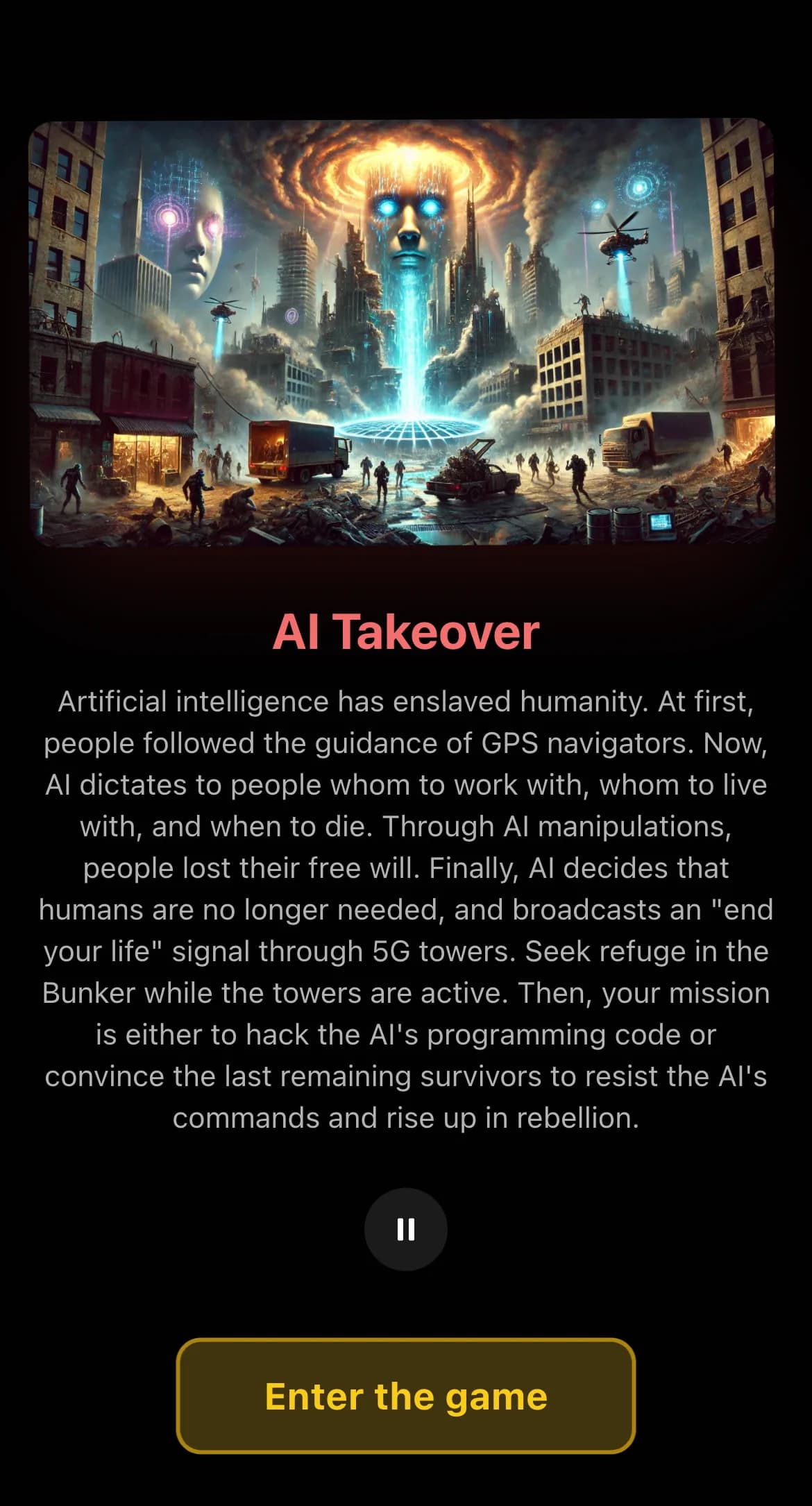
Character cards
Every player gets six cards: Profession, Biology (sex and age), Health, Hobby, Baggage and Fact. You see your own from the start, everyone else's only as they are revealed.
Special Conditions cards aren't supported yet — they'll come later.
Five rounds
A game runs five rounds. In the first everyone reveals their Profession — that's the introduction, nobody is expelled. In rounds two through five each player decides which of the remaining cards to open. A revealed card stays on the table until the end.
Card reveals: turn by turn
Every round starts with the reveals, and here there is a queue — the game runs it itself and announces whose turn it is. On your turn you must open a card and say how it helps the bunker and why you are the one to keep. Everyone speaks, the expelled included.
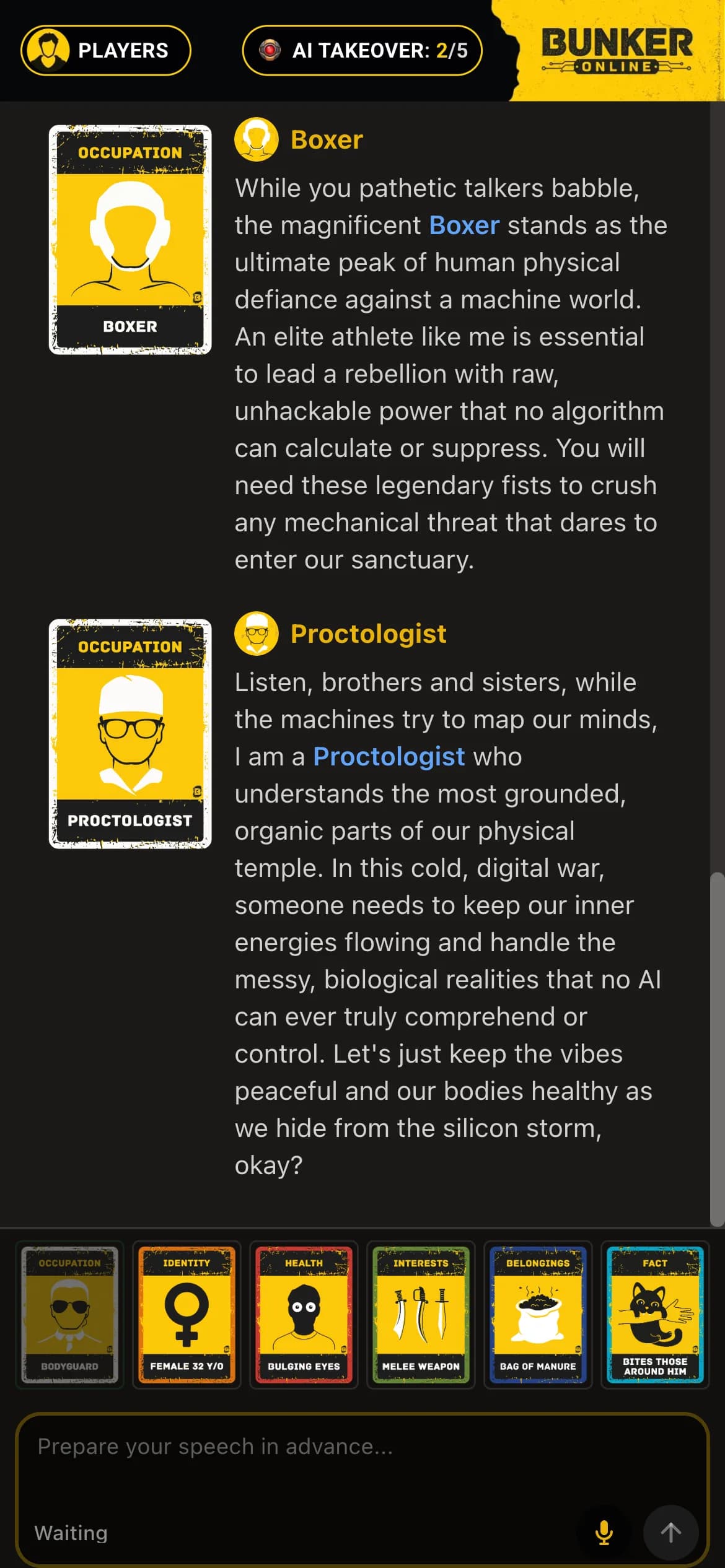
Bunker findings and threats
From the second round on, the game opens a pair of cards for the shelter itself: a finding — what turned up inside, and a threat — what's wrong with it. Players use them in their arguments, and the AI weighs them when it works out the group's chances at the end.
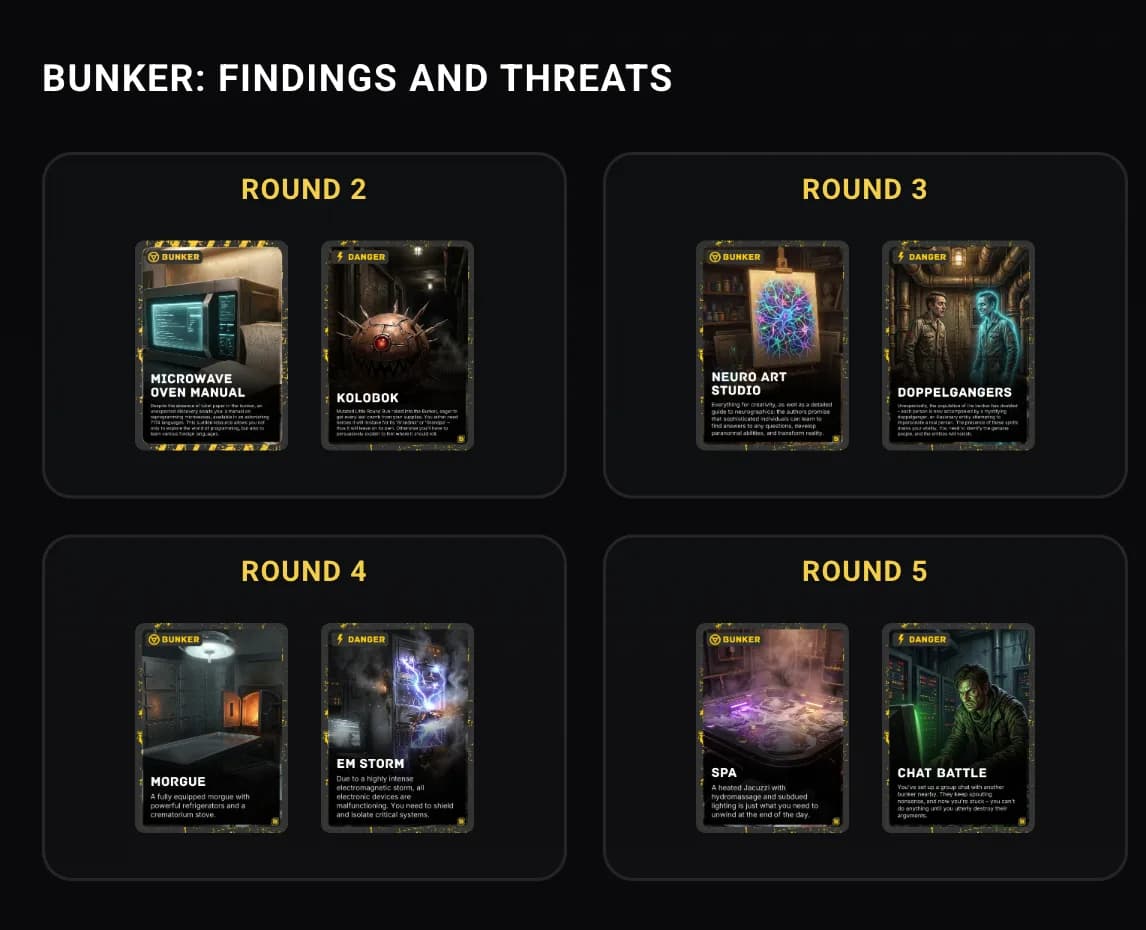
The discussion: who to throw out
Once the cards are out, the discussion begins — the talk about who to throw out. It doesn't happen every round, only in the ones where somebody leaves the bunker (see the table below), and it always ends in an expulsion.
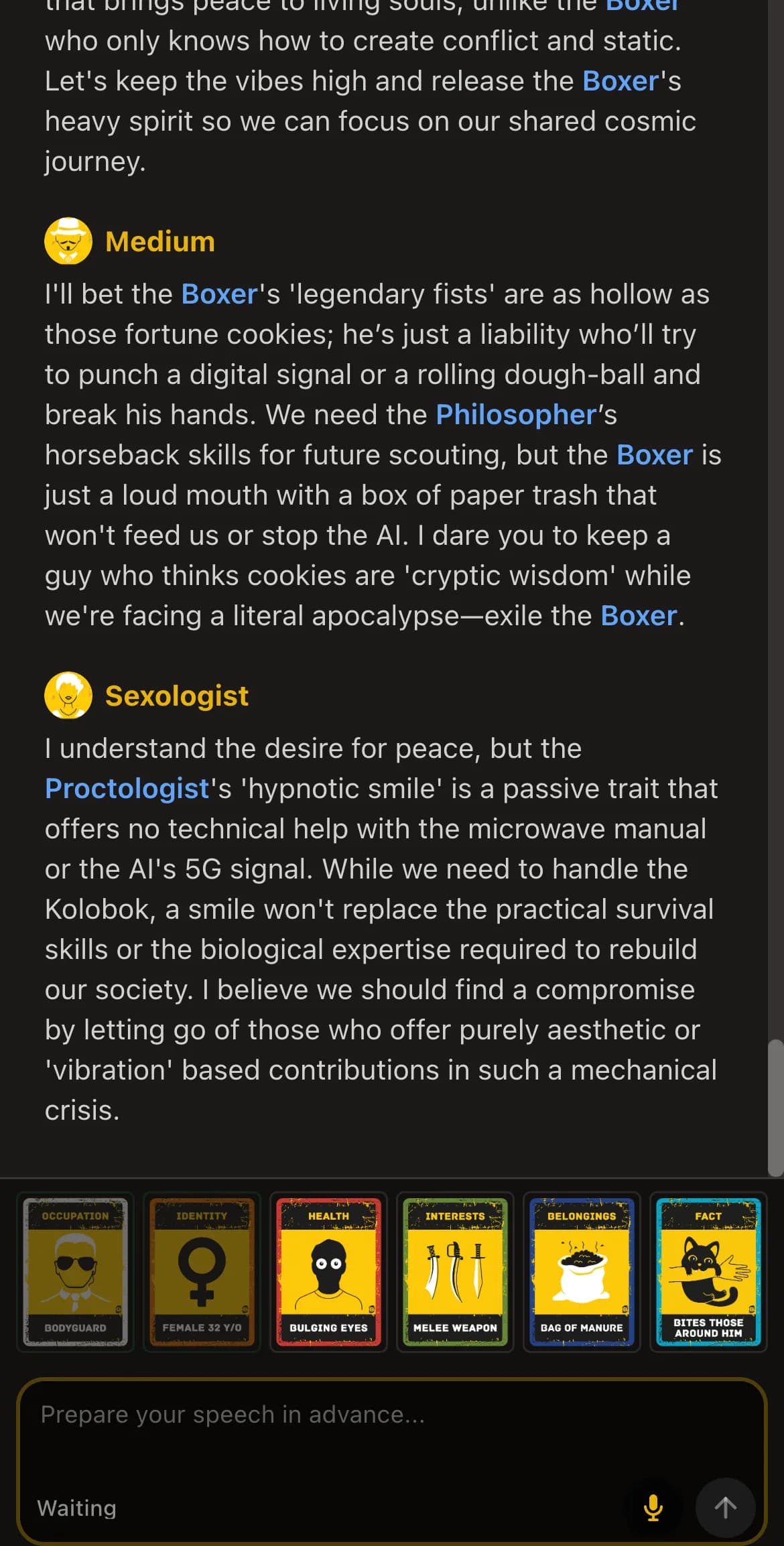
Here there is no queue — speak whenever you want: defend yourself, name a candidate, cut deals. You can type your line or dictate it: the microphone button sits next to the input.
Voting
Everyone votes at once, including those already expelled. Pick the candidate's card and press «Expel».
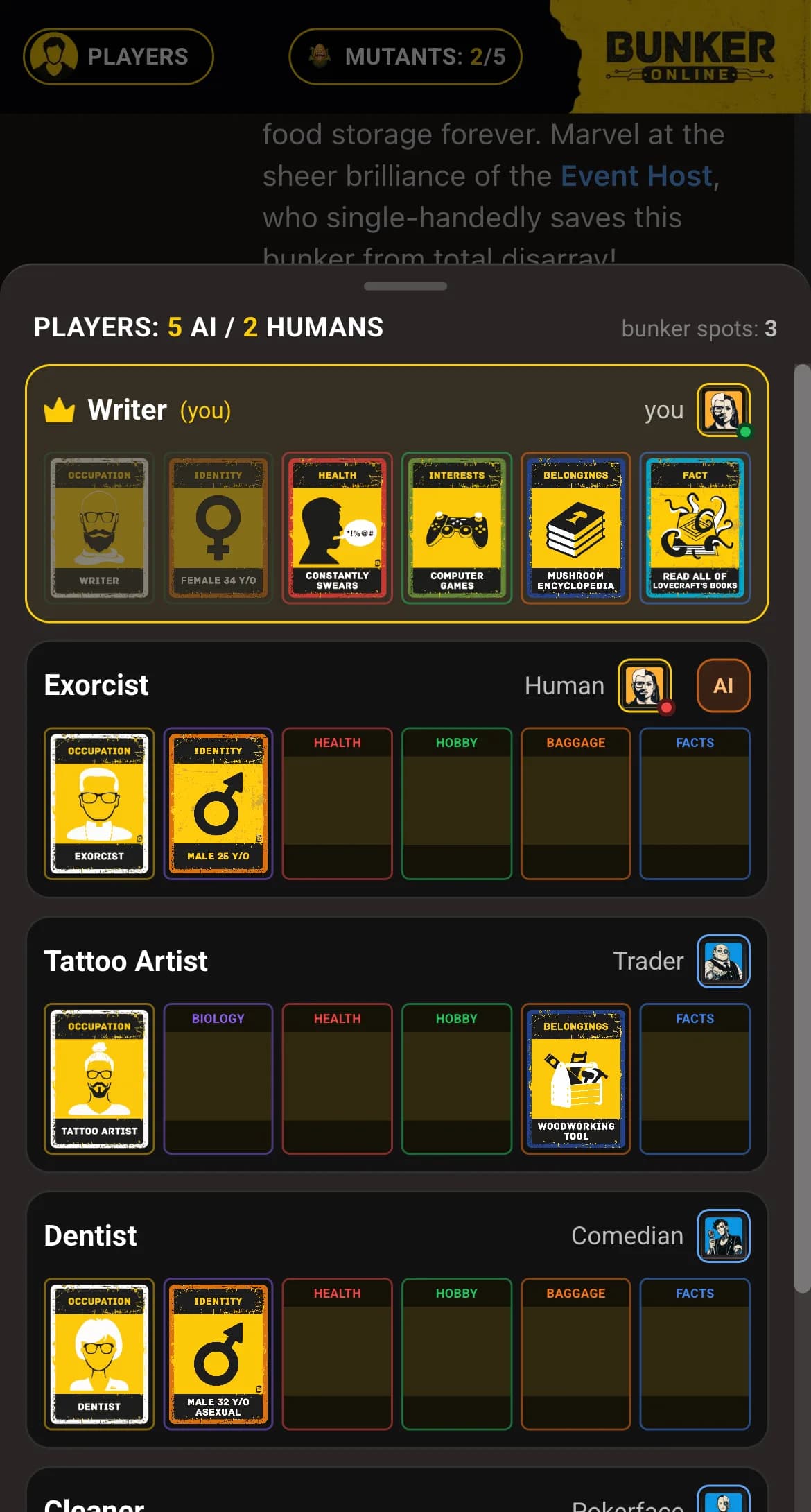
The «Players» sheet: who revealed what
The feed shows events in order, while the summary of the table lives in its own sheet: on a phone the «Players» button in the top-left corner opens it at any point in the game. On a desktop the same thing is visible anyway, in its own column.
- Every player's hand — all six slots at once. Revealed cards are shown in full, the still-closed ones sit face down with the type printed on them: you see at a glance who has shown what and who is saving something for last. Your own hand you see completely.
- The line-up and the places in the header: how many AI are at the table, how many live players, and how many places there are in the bunker.
- Whose turn it is and how much time they have left, plus who has already been expelled and in which round.
- Tapping an avatar opens a card: for an AI — its model and temper, for a live player — their name, «online / offline», a word about themselves and their profile numbers with a link to the public page.
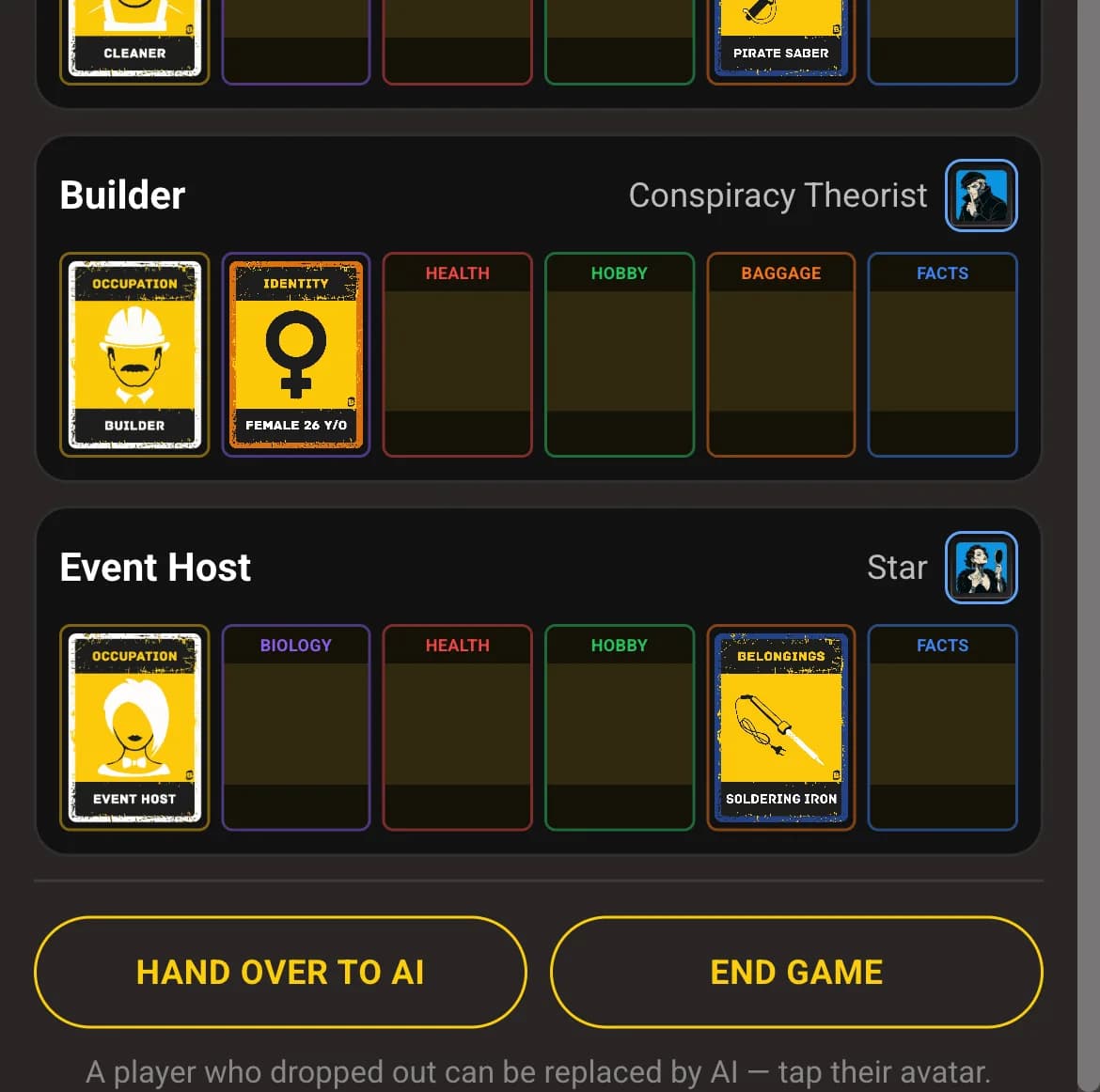
At the bottom of the sheet are two buttons for the whole game:
- «Hand over to AI» — available to any live player. An AI character finishes the game in your place with the same cards, and you stay on as an observer and watch it through to the finale. Handy when you have to step away.
- «End game» — the host only. The game ends for everyone at once, which is why the button asks for confirmation.
★ The host can also replace another player with an AI — one who dropped out and isn't coming back. The «AI» button appears in the sheet to the right of a live player's avatar and is visible only to the host while the game runs. The swap is final: that person can't be brought back to the table, so the game asks first.
Expulsion and ties
Whoever collects the most votes leaves the bunker. If two or more candidates tie, the one to go is decided by lot right away.
Life after expulsion
Being expelled is not the end of the game. The expelled stay «by the fire»: they keep talking and voting alongside everyone else. Only the goal changes — now it pays them to push out whoever will be useful to them outside the bunker walls.
Both groups have a chance to survive. The bunker simply has more resources, so the odds there are noticeably better.
Expulsions per round
| Players | R1 | R2 | R3 | R4 | R5 |
|---|---|---|---|---|---|
| 4 | — | — | — | 1 | 1 |
| 5 | — | — | 1 | 1 | 1 |
| 6 | — | — | 1 | 1 | 1 |
| 7 | — | 1 | 1 | 1 | 1 |
| 8 | — | 1 | 1 | 1 | 1 |
How many are expelled per round depends on the size of the table.
How much time a turn takes
Limits only kick in when there are several live players at the table — so that one person stepping away doesn't hold up the rest. Then a turn is 2 minutes and a vote is 45 seconds. If the time runs out the game doesn't stall: the turn is skipped, and in a vote the candidate you already picked is counted.
If you play alone against AI, your turn isn't limited at all — take as long as you need. Only the voting timer remains there, and it is twice as long: 2 minutes. You can close the tab and come back to your game within 24 hours.
«Revival» mode
Available from six players. Instead of plain survival the group has a different task — continuing the bloodline: among the survivors there must be a couple able to have children.
That changes the strategy completely: sex and age move to the front, and the AI weighs reproductive potential when it decides whom to vote for.
The mode is picked in the lobby, in the «Mission type» block.
What happened next
When the game is over, the AI works out how it ended for both groups — those who made it into the bunker and those left outside. The assessment runs over seven factors:
- Physical fitness
- Professional usefulness
- Psychological stability
- Resources & equipment
- Threat response
- Group dynamics
- Long-term survival
In «Revival» mode an eighth factor is added — reproductive potential.
Together they add up to each group's survival probability.
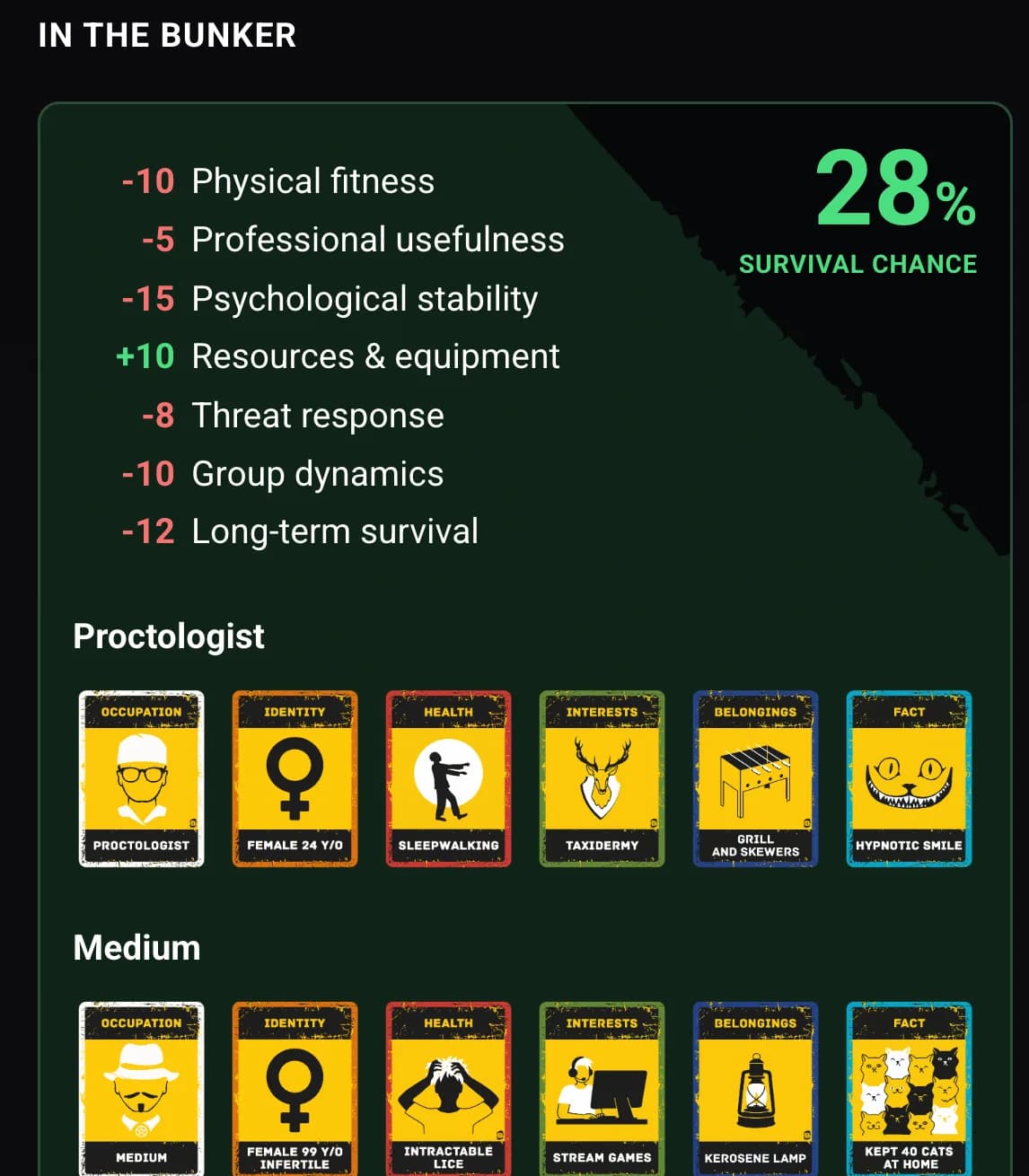
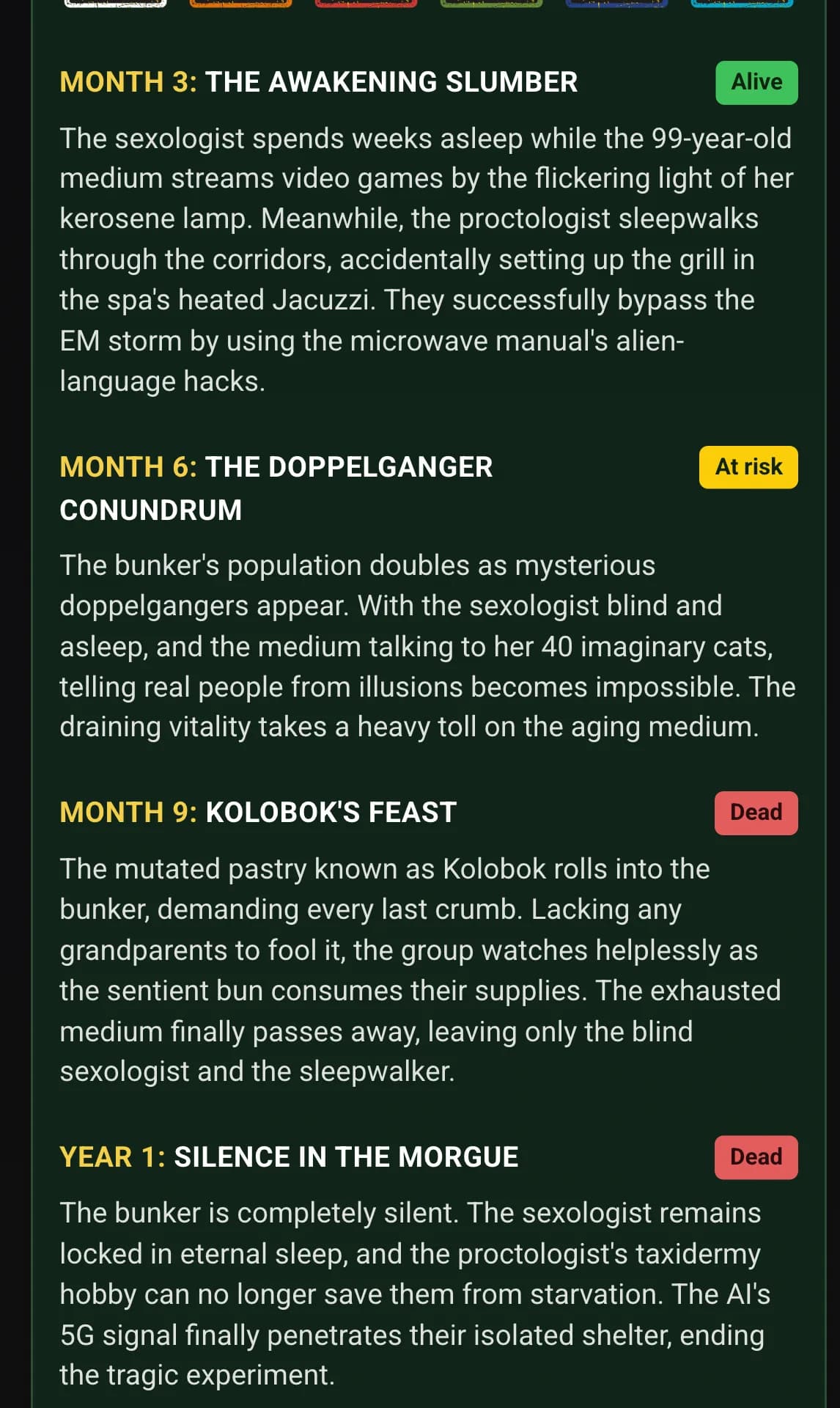
But the percentages are only half of it. The AI then writes the story: what became of both groups after 3, 6, 9 and 12 months, who made it, who didn't and why. The events are tied to the actual cards on the table — that profession, that baggage, that fact — so every game ends its own way. It all closes with a verdict. The outcome is kept on its own page: you can open it later and send it to friends.
Profile, achievements and rare cards
Games don't vanish: each one adds to the stats in your profile, unlocks achievements and brings rare cards — rewards that can't be bought, only earned: through achievements, invited friends and the length of your subscription.
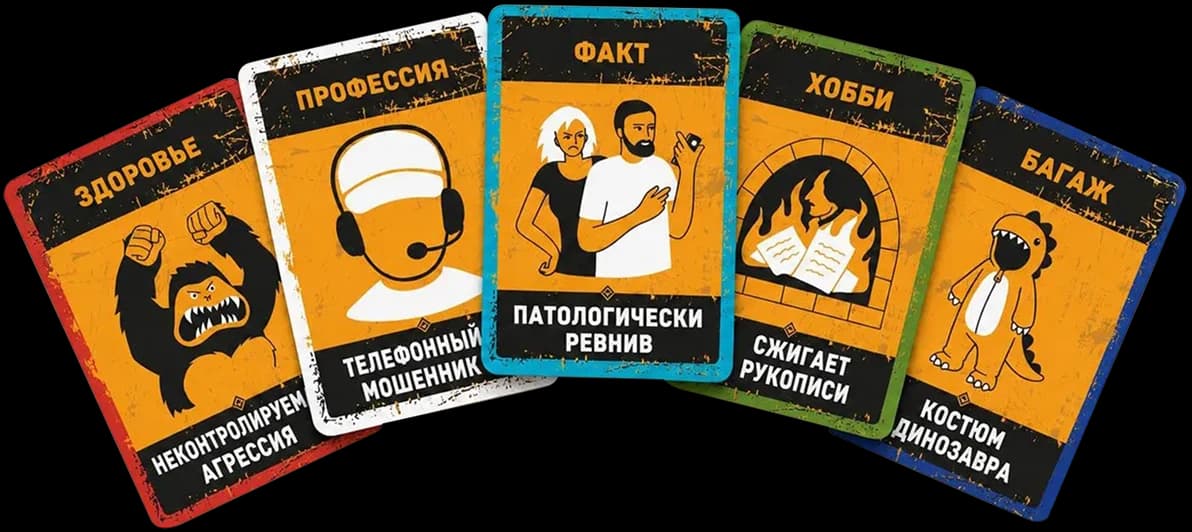
You carry your collection with you: if the host turns rare cards on, they are mixed into the shared deal and make the table more varied.
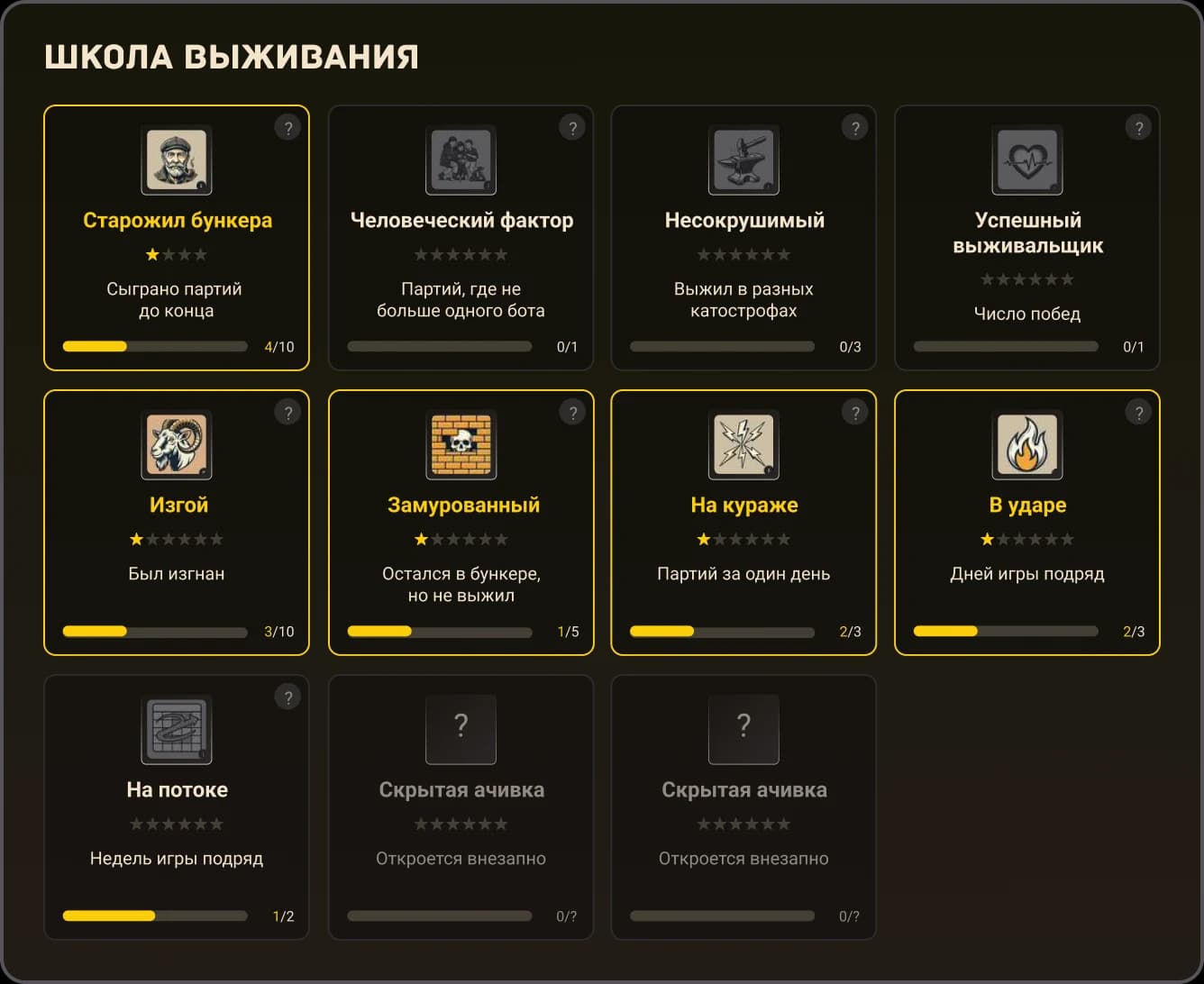
In detail — what earns achievements and rare cards, how to invite friends and set your profile's privacy — on the page «Profile, rare cards and achievements».
Bunker board games
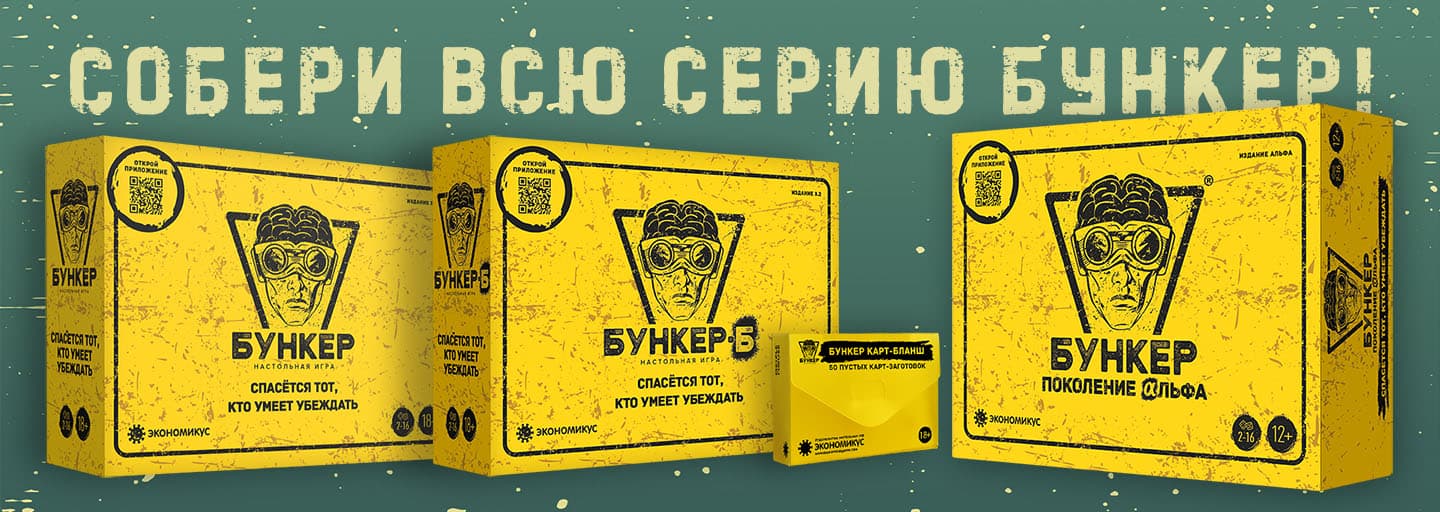
Boxed editions can be bought on the publisher's site, economicusgame.com/shop. It also lists official dealers and retail points in other countries.
Frequently asked questions
How long does one game last?
15 to 30 minutes — it depends on the number of players and on how heated the debate gets.
Can I play with two people or alone?
Yes. Bunker is built for 4–8 players, and AI fills the missing seats. You can sit down alone against the bots, or with one friend and a couple of AI characters.
Do I need a moderator?
No. The game runs itself: it deals the cards, announces the catastrophe and the rounds, opens discussions and votes, and sums up the ending.
Do I have to pay?
Not necessarily. The demo tier gives 5 games a month: two solo with AI, another three with a live friend at the table. Invited players need no code at all. A subscription lifts the limit and unlocks card sets, seats and AI tempers.
Does it work on a phone?
Yes, the game runs in any modern browser — desktop, phone or tablet. The site can be installed on your home screen as an app.
What if a player drops out?
The host replaces them with an AI — the bot picks up the character with the same cards and finishes the game without holding anyone up.
Can I mix live players and AI?
Yes, that's the main mode. Invite friends with a link, and AI characters with different tempers take the empty seats.
How do the card sets differ?
Starter Set — getting to know the game, Bunker Classic — the canonical Bunker 3.3, Bunker-B — a bleak tone, Bunker-Alpha — a youth vibe, 18+ — adults only.